Fire Risk Assessment in Scotland PAS79
Under the Fire (Scotland) Act 2005 and the Fire Safety (Scotland) Regulations 2006, employers and persons with control of premises (dutyholders) are legally required to carry out an assessment of the risk of harm from fire and to implement appropriate fire safety measures.
A fire risk assessment is not simply a checklist exercise. It is a structured and methodical evaluation of fire hazards, fire protection measures, means of escape and management arrangements to determine whether risks to relevant persons are adequately controlled.

Our approach to Fire Risk Assessment
HESTIA delivers thorough, proportionate and defensible Fire Risk Assessments, grounded in the principles of PAS 79‑1 and tailored to each building’s use, layout and occupancy
Our assessments typically include:
- Identification of ignition sources and combustible materials
- Evaluation of compartmentation and fire separation
- Assessment of means of escape and travel distances
- Review of fire detection and alarm systems
- Inspection of emergency lighting provision
- Review of fire safety management arrangements
- Consideration of vulnerable occupants
Each assessment results in a detailed written report, clearly identifying findings and providing prioritised, practical recommendations where required.
You can find out more about what to expect from our visit.
What makes a Fire Risk Assessment appropriate?
Scottish fire safety legislation does not prescribe a fixed methodology for carrying out a fire risk assessment. However, it requires dutyholders to undertake an assessment that properly reflects the nature of the premises, the level of fire risk present, and the needs of relevant persons.
An effective fire risk assessment should be proportionate to the complexity and occupancy of the building, identify significant findings clearly, and provide practical recommendations to reduce risk where necessary. The assessment must be sufficiently detailed to inform fire safety management decisions and support compliance with statutory duties.
Our approach is structured, methodical and tailored to the specific characteristics of each premises. Drawing on extensive operational and enforcement experience, we ensure that findings are realistic, defensible and aligned with recognised guidance and industry best practice.
Competence of the Fire Risk Assessor
The quality and reliability of a fire risk assessment depends significantly on the competence of the person undertaking it. Scottish legislation requires dutyholders to ensure that fire safety arrangements are appropriate to the risk, and this includes appointing an assessor with the necessary skills, knowledge and experience to carry out the assessment effectively.
A competent fire risk assessor should be able to understand building construction and fire behaviour, interpret relevant legislation and guidance, evaluate fire protection systems, and apply proportionate judgement based on the specific characteristics of the premises. They must also be capable of identifying significant findings clearly and communicating practical, risk-based recommendations.
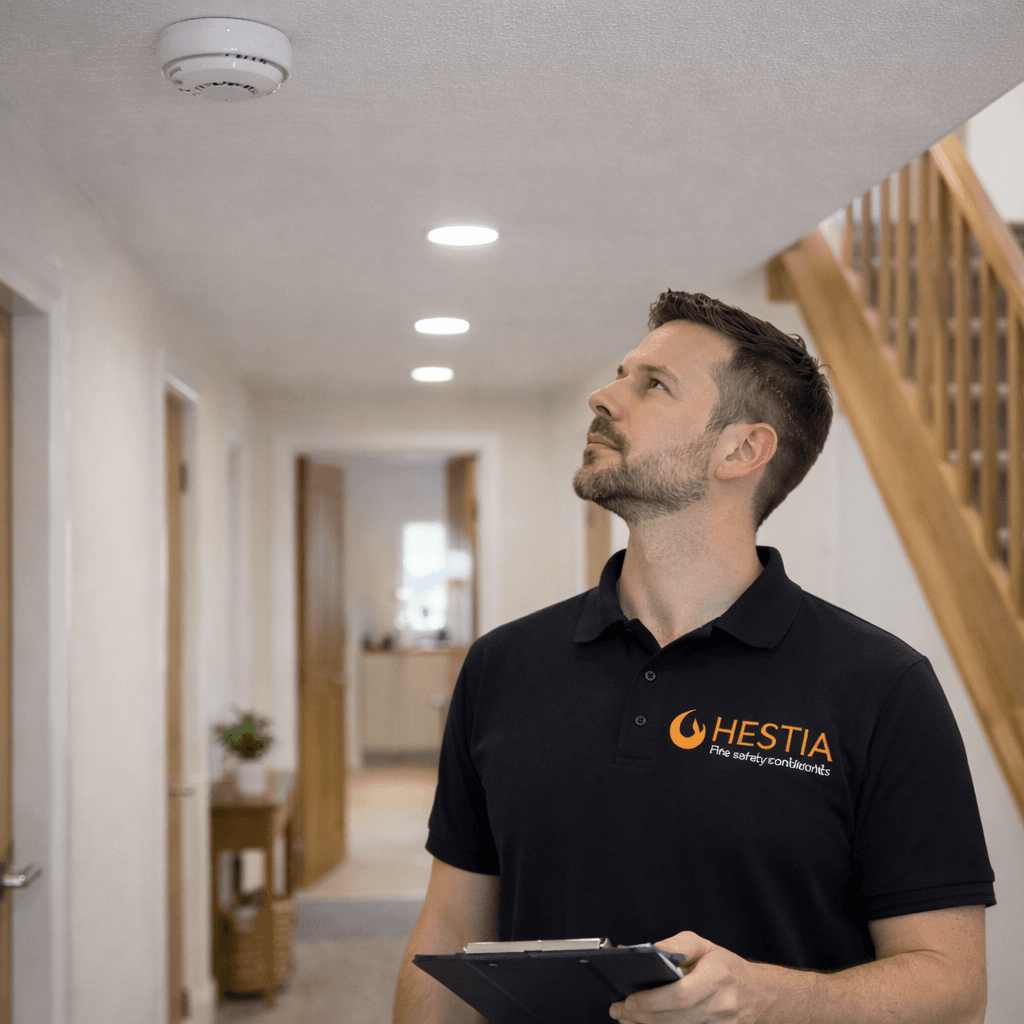
Our assessments are undertaken by professionals with extensive operational and fire safety enforcement experience, bringing a balanced understanding of both regulatory expectations and real-world fire risk management. This ensures that assessments are not only technically sound, but also practical, defensible and aligned with current industry best practice.
Who requires a Fire Risk Assessment?
We regularly conduct fire risk assessments for:
- Houses in Multiple Occupation (HMOs)
- Short-Term Lets (STLs)
- Hotels, guest houses and bed & breakfasts
- Offices and commercial premises
- Retail and industrial units
Assessments are adapted to the specific risk profile and statutory requirements applicable to each premises type.
Fire Risk Assessments for landlords and Short-Term Let operators in Scotland
Landlords and short-term let operators in Scotland have specific responsibilities in relation to fire safety within their premises. A suitable and sufficient fire risk assessment should consider the layout of the property, the number and type of occupants, escape arrangements and the provision of appropriate detection and warning systems.
In many cases, those responsible for rented accommodation or licensed short-term lets rely on a competent fire safety professional to undertake a structured assessment and provide practical recommendations to help ensure the premises meets the requirements of Scottish fire safety legislation and local authority licensing conditions. Many Scottish local authorities require evidence of appropriate fire safety arrangements as part of the short-term let licensing process.
HESTIA provide fire risk assessments for landlords and short-term let operators across Scotland, including rented flats, houses in multiple occupation (HMOs), and short-term let properties such as holiday lets and serviced accommodation. Our assessments are carried out using a structured methodology aligned with recognised fire safety guidance and are designed to provide clear, practical recommendations to help dutyholders manage their fire safety responsibilities.
Fire Risk Assessment as an ongoing process
A fire risk assessment is not a one-off document. It forms part of continuous fire safety management and must be kept under regular review.
Scottish fire safety legislation does not prescribe a fixed review period. Instead, dutyholders are required to ensure that their assessment remains current and reflective of the actual risk within the premises. In practice, this means reviewing the assessment:
- When there are significant changes to the building layout, occupancy or processes
- Following alterations or refurbishment works
- After a fire or significant incident
- Where new hazards are introduced
- Periodically as part of routine fire safety management
For many premises, a formal review annually is considered good practice. Higher-risk environments or those with frequent change may require more frequent review.
Maintaining an up-to-date assessment supports the “golden thread” of fire safety information and provides documented evidence of ongoing compliance should scrutiny arise from enforcing authorities, insurers or other stakeholders.
Frequently Asked Questions
How often must a fire risk assessment be reviewed?
Scottish legislation does not specify a fixed review period. However, fire risk assessments must be kept up to date and reviewed regularly, particularly where there are material alterations, changes in occupancy, changes in use, or following a fire-related incident.
Is a fire risk assessment a legal requirement in Scotland?
Yes. Under the Fire (Scotland) Act 2005 and the Fire Safety (Scotland) Regulations 2006, dutyholders are legally required to assess the risk of harm from fire and implement appropriate fire safety measures.
What should a fire risk assessment include?
A fire risk assessment should identify significant fire hazards, evaluate the adequacy of existing fire safety measures, assess means of escape and fire protection systems, and provide clear recommendations where improvements are required.
Will I receive a written report?
Yes. A detailed written report is provided outlining significant findings and prioritised recommendations. This documentation supports effective fire safety management and contributes to maintaining an accurate record of compliance information.
Ready to arrange your fire risk assessment? Contact HESTIA today to discuss your premises and arrange a visit.
Do landlords or short-term let operators need a fire risk assessment?
Scottish fire safety legislation requires those responsible for premises to assess the risk from fire and take appropriate measures to protect relevant persons. For landlords and short-term let operators, this means considering fire safety within their properties and ensuring suitable precautions are in place for occupants and guests. A fire risk assessment provides a structured way of identifying hazards and determining whether existing fire safety measures are adequate.
